The dates on this page have been checked against the Atatürk Ansiklopedisi (Atatürk Encyclopaedia), the Nutuk, the publications of the Turkish Historical Society and reference works based on them. Where the sources give a different day, the most widely accepted date has been given; for events whose day is not known for certain, only the month or the year is given.
The heading of each period opens the detailed page of that period.
I · A child in Thessaloniki
1881 – 1899He is born in Thessaloniki (Selanik), in the three-storey house in the Koca Kasım Paşa quarter. His father is Ali Rıza Efendi, his mother Zübeyde Hanım. There is no record showing the day of his birth.
His siblings born before him, Fatma, Ömer and Ahmet, have died young. Of the siblings born after him, only Makbule will reach adulthood.
At his mother’s wish he begins, with a ceremony, at the neighbourhood school; a few days later his father enrols him in the Şemsi Efendi School, which teaches by the new method.
His father Ali Rıza Efendi dies (according to many sources; some sources, including the Atatürk Ansiklopedisi, give 1893). Zübeyde Hanım takes her children to Rapla Farm near Langaza, to her elder brother Hüseyin Ağa.
He is sent to Thessaloniki, to his aunt, so that he can study. He is enrolled at the Mülkiye Rüştiyesi (civil middle school); after a harsh beating from a teacher he leaves the school.
Without telling his mother, he sits the examination and enrols at the Thessaloniki Military Middle School. His mathematics teacher, Captain Mustafa Sabri Bey, gives him the name “Kemal”.
Zübeyde Hanım marries Ragıp Bey. The young Mustafa Kemal finds this marriage hard to accept.
He finishes middle school and moves on to the Military High School in Manastır (Bitola). Under the influence of his friend Ömer Naci he develops a love of literature and oratory; he improves his French.
He completes the Military High School in Manastır.
In Istanbul he enrols in the infantry class of the Mekteb-i Harbiye (War College).
II · The young officer
1899 – 1914He studies at the War College. He is among the students who secretly put out a handwritten newspaper at the school; he reads Namık Kemal and forbidden publications.
He graduates from the War College as an infantry lieutenant and earns the right to enter the Staff Academy (Mekteb-i Erkân-ı Harbiye), which trains staff officers.
While studying at the academy he is promoted to first lieutenant.
He graduates from the Staff Academy as a staff captain.
He is arrested on the grounds that he and his friends held meetings criticising the government; after several weeks of interrogation he is released.
He is posted to the 30th Cavalry Regiment of the Fifth Army, headquartered in Damascus. He serves in Syria and Palestine.
In Damascus, together with a few friends, he founds the secret Society of Homeland and Freedom (Vatan ve Hürriyet).
He is promoted to the rank of kolağası (senior captain).
He is posted to the Third Army in Macedonia and returns once more to Thessaloniki. He joins the Committee of Union and Progress.
The Second Constitutional Era is proclaimed.
He is sent on a short mission to Tripolitania; he studies the situation in the region and returns to Thessaloniki.
The 31 March Uprising breaks out in Istanbul. He serves as a staff officer in the Action Army that sets out from Thessaloniki; it is he who gives the army its name.
The Action Army enters Istanbul; the uprising is put down.
He serves as a staff officer to Mahmut Şevket Pasha in the suppression of the uprising in Albania.
In France, he is part of the Ottoman delegation observing the army manoeuvres in Picardy.
He is appointed to the General Staff at the Ministry of War in Istanbul.
Italy declares war on the Ottoman State. The war in Tripolitania begins.
He leaves Istanbul under the guise of a journalist; he crosses secretly into Libya by way of Egypt.
He is promoted to major.
At Tobruk he leads a successful attack on Italian positions.
In the fighting around Derna he is wounded in the eye and is treated for a month.
He is made Commander of Derna.
The Balkan War begins. On 18 October the Treaty of Ouchy is signed with Italy; on 24 October he leaves Tripolitania.
Thessaloniki, the city of his birth, falls into the hands of the Greek army. His mother and sister are forced to leave as refugees.
He serves as head of the operations branch of the Mediterranean Straits Special Forces Command (Bolayır), formed at Gelibolu.
The Treaty of London is signed; Edirne is ceded to Bulgaria.
In the Second Balkan War he is among the units advancing into Thrace with the Bolayır Corps. Edirne is retaken.
He is appointed military attaché in Sofia; he arrives in Sofia on 20 November.
He is promoted to lieutenant colonel.
The First World War begins. From Sofia he sends reports stating that neutrality should be maintained.
The Ottoman State formally enters the war on the side of Germany.
III · Gallipoli (Çanakkale)
1915He is appointed commander of the 19th Division, to be formed at Tekirdağ.
He forms the 19th Division; the division is soon sent to the Gallipoli Peninsula, to the area around Maydos (Eceabat).
The Entente fleet tries to force the Dardanelles and withdraws with heavy losses.
Australian and New Zealand troops land at Arıburnu (Anzac Cove). Without waiting for orders he drives the 57th Regiment to Conkbayırı (Chunuk Bair); the landing’s advance inland is halted.
New counter-attacks at Arıburnu; the front sinks into the trenches.
He is promoted to colonel.
The British make a new landing at Anafartalar (Suvla); the same night a major attack from Arıburnu on Conkbayırı begins.
He is made Commander of the Anafartalar Group.
First Battle of Anafartalar: the landed troops are pushed back towards the shore.
At dawn he personally leads the counter-attack at Conkbayırı. A shrapnel fragment that strikes his chest is stopped by the watch in his pocket.
The fighting at Kireçtepe; the landing forces cannot advance northwards.
Second Battle of Anafartalar. The last great attack of the Entente forces is also halted.
The front freezes; disease and winter take soldiers from both sides. He himself falls ill.
He leaves the command of the Anafartalar Group and comes to Istanbul.
The Entente forces withdraw from Arıburnu and Anafartalar.
The last troops are withdrawn from Seddülbahir (Cape Helles) as well. The land war at Gallipoli ends.
IV · Collapse and resolve
1916 – 1919He becomes commander of the XVI Corps in Edirne; the corps is soon sent to the Eastern Front, to Diyarbakır.
He is promoted to the rank of mirliva (brigadier general). He is now “Mustafa Kemal Pasha”.
His corps retakes Bitlis and Muş from the Russian army.
He becomes Acting Commander of the Second Army.
He is appointed commander of the Seventh Army, part of the Yıldırım Army Group on the Syrian front.
He writes a long report that sets out plainly the state of the army and of the country, and criticises the plans of the German commanders.
Following disagreements he leaves his command and returns to Istanbul.
He accompanies the Crown Prince Vahdettin on his journey to Germany; he sees the front and the German generals at close quarters.
Because of a kidney ailment he is treated in Vienna and in Karlsbad. The diary he kept in Karlsbad can be read today.
Sultan Mehmed V Reşad dies; he is succeeded by Mehmed VI Vahdettin.
He is again appointed commander of the Seventh Army; he goes to the Nablus front.
The British launch their great offensive in Palestine; the front collapses. He succeeds in withdrawing the Seventh Army northwards without it disintegrating.
North of Aleppo, at Katma, he halts the British advance. The line of the new border begins to emerge here.
The Armistice of Mudros is signed. The Ottoman State has lost the war.
He takes over command of the Yıldırım Army Group from Liman von Sanders.
The Yıldırım Army Group is dissolved; he is called to Istanbul, at the disposal of the Ministry of War.
On the day he returns to Istanbul, the Entente fleet too is dropping anchor in the Bosphorus. The city is in effect under occupation.
He settles, with his mother and sister, into the house he has rented in Şişli.
In Istanbul he meets politicians and officers; he meets Sultan Vahdettin several times. He looks for a way to cross into Anatolia.
He is appointed Inspector of the Ninth Army (later the Third Army Inspectorate), based in Samsun. This post, carrying wide powers, opens the door of Anatolia to him.
The Greek army occupies İzmir.
With the small staff at his side, he boards the steamer Bandırma and leaves Istanbul.
V · The National Struggle
1919 – 1922He lands at Samsun. Years later he will give this day as his own birthday.
He moves on to Havza; he makes the Mesudiye Hotel his headquarters.
The Havza Circular: he calls for the occupations to be protested everywhere with rallies.
He arrives in Amasya.
The Amasya Circular: “The independence of the nation will again be saved by the nation’s own resolve and determination.” The decision to convene a congress in Sivas is announced.
The Istanbul government notifies the provincial governors that it has dismissed him from his post.
He arrives in Erzurum.
At midnight he resigns both from his post as inspector and from the army. He will now carry on the struggle as a civilian.
The Erzurum Congress convenes and elects him chairman. The congress lasts until 7 August; it is declared that the homeland is a whole and cannot be divided.
He arrives in Sivas.
The Sivas Congress. The societies for the defence of rights throughout the country are united under a single roof; he becomes chairman of the Representative Committee (Heyet-i Temsiliye).
The Amasya Talks: protocols are signed between Salih Pasha, representing the Istanbul government, and the Representative Committee.
In the elections for the Chamber of Deputies he is elected deputy for Erzurum.
He comes to Ankara together with the Representative Committee.
The last Ottoman Chamber of Deputies opens in Istanbul.
The Chamber of Deputies adopts the Misak-ı Millî (National Pact).
The Entente powers formally occupy Istanbul; some of the deputies are arrested and exiled to Malta.
The Grand National Assembly opens in Ankara. The next day he is elected President of the Assembly.
The court martial in Istanbul sentences him and his comrades to death in absentia.
The Treaty of Sèvres is signed. Ankara does not recognise this text, which partitions Anatolia.
On the Eastern Front, the army under the command of Kâzım Karabekir Pasha takes Kars.
With the Treaty of Gümrü (Alexandropol), the war on the eastern border ends.
First Battle of İnönü. The first victory of the newly formed regular army.
The first constitution, the Teşkilât-ı Esasiye Kanunu, is adopted: sovereignty belongs unconditionally to the nation.
The İstiklal Marşı (Independence March), written by Mehmet Âkif, is adopted in the Assembly.
The Treaty of Moscow is signed with Soviet Russia.
Second Battle of İnönü. In the telegram he sends to İsmet Pasha, he writes that the army has overcome not only the enemy but “also the ill fate of the nation”.
The battles of Kütahya–Eskişehir. The army withdraws east of the Sakarya; anxiety grows in Ankara.
The Assembly elects him Commander-in-Chief with full powers.
The Tekâlif-i Millîye (National Obligations) orders: every household gives food, clothing and transport for the army.
The pitched Battle of Sakarya. In a battle lasting twenty-two days and twenty-two nights, the Greek army is forced to withdraw.
The Assembly confers on him the rank of marshal and the title of gazi.
The Treaty of Kars is signed with the Caucasian republics.
The Treaty of Ankara is signed with France; the southern front is closed.
Preparations for the great offensive are completed in secrecy; headquarters move from Akşehir to Şuhut, and from there to Kocatepe.
At dawn the Great Offensive begins from Kocatepe.
The Battle of the Commander-in-Chief. Around Dumlupınar the main force of the Greek army is encircled and defeated.
His order to the armies: “Armies! Your first objective is the Mediterranean. Forward!”
Turkish cavalry enter İzmir. The next day he himself comes to İzmir.
The last Greek units in Western Anatolia also withdraw.
The Armistice of Mudanya is signed. Eastern Thrace is to be recovered without war.
The Grand National Assembly abolishes the sultanate.
The last sultan, Mehmed VI Vahdettin, leaves Istanbul aboard a British warship.
The Lausanne Peace Conference opens. İsmet Pasha heads the Turkish delegation.
VI · The Republic
1923 – 1938His mother Zübeyde Hanım dies in İzmir, in Karşıyaka. He receives the news while on a tour of western Anatolia; at the end of the month he comes to İzmir and visits her grave.
In İzmir he marries Latife Hanım.
He opens the İzmir Economic Congress.
The Assembly decides to renew the elections; elections for the Second Assembly are held.
The Treaty of Lausanne is signed. The independence of the new Turkey is recognised internationally.
He is elected President of the Second Grand National Assembly.
He founds the People’s Party.
After the departure of the occupying forces, Turkish troops enter Istanbul.
Ankara becomes the seat of the state, that is, the capital.
At dinner at Çankaya he tells his friends that the Republic will be proclaimed the next day.
The Republic is proclaimed. The Assembly unanimously elects him the first President.
The caliphate is abolished. On the same day the Tevhid-i Tedrisat (Unification of Education) law is adopted; the Ministry of Religious Law and Pious Foundations is abolished.
The new Teşkilât-ı Esasiye Kanunu, the Constitution of 1924, is adopted.
A great tour of the country lasting more than fifty days: on 30 August he celebrates Victory Day at Dumlupınar; from the Black Sea coast he goes on to Erzurum and Kars.
The Assembly moves into its new building in Ankara (today’s Museum of the Republic).
The first opposition party, the Progressive Republican Party, is founded.
The Sheikh Said uprising begins in the east.
The Law on the Maintenance of Order (Takrir-i Sükûn) is passed. In June the Progressive Republican Party is closed down.
On the barren land of Ankara he founds the Forest Farm (Orman Çiftliği).
He divorces Latife Hanım.
He sets out on a journey to Kastamonu; he appears before the people with his hat in his hand, and in İnebolu and Kastamonu gives speeches on dress.
The Hat Law is adopted.
The dervish lodges, convents and shrines are closed.
The international time and calendar are adopted; they are applied from 1 January 1926.
The Turkish Civil Code is adopted. Women and men are regarded as equal in family law; the code comes into force on 4 October 1926.
A plot to assassinate him, prepared in İzmir, is uncovered.
He comes for the first time in eight years to Istanbul, which he left on 16 May 1919; he stays at the Dolmabahçe Palace.
At the congress of the People’s Party he reads the Nutuk: six days, thirty-six and a half hours.
He is elected President for the second time.
The article “The religion of the state is Islam” is removed from the constitution.
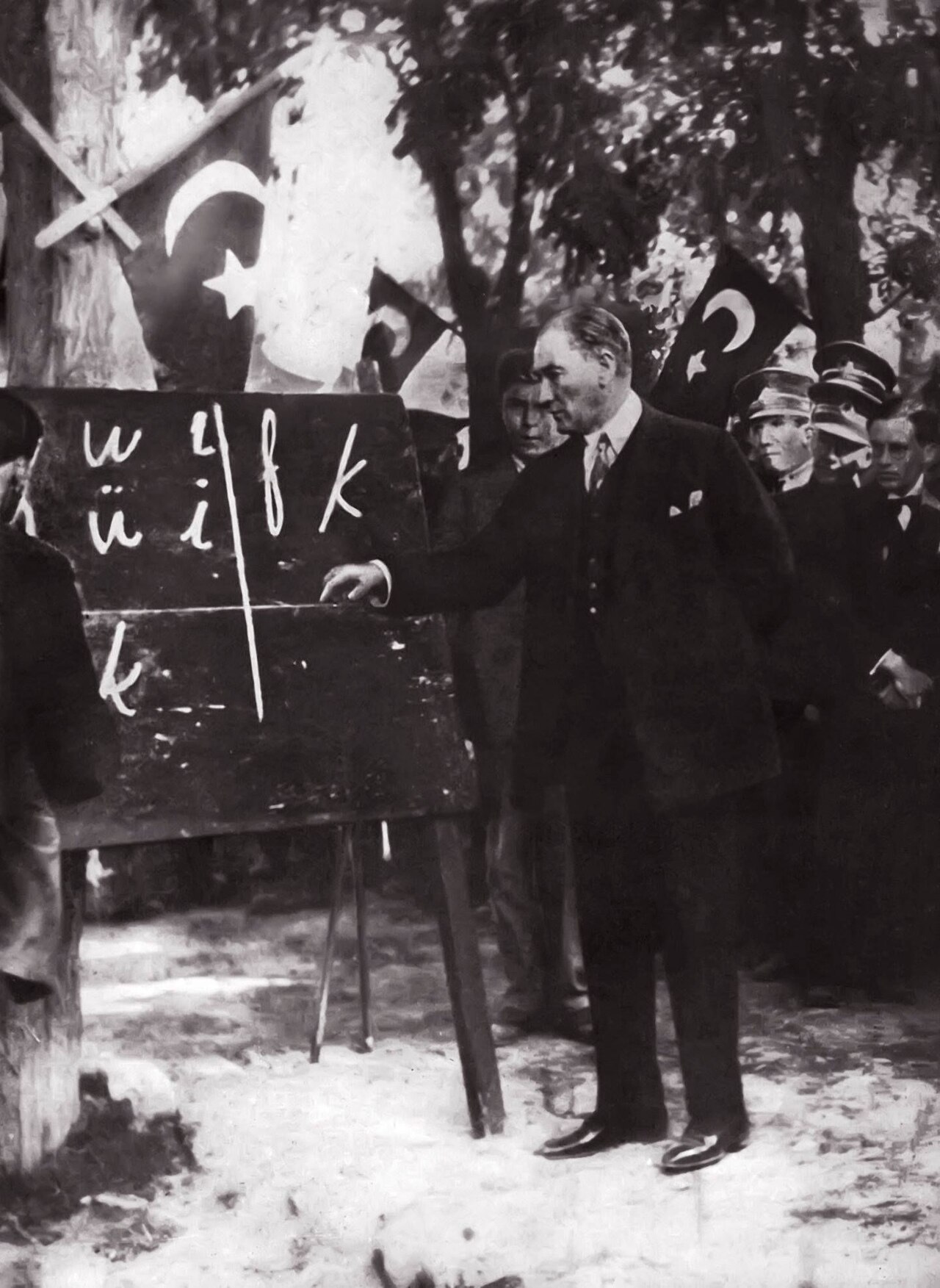
In Istanbul, at Sarayburnu, he introduces the new Turkish letters to the people.
On his journeys through the country he stands at the blackboard and teaches the new letters himself; the people call him “Başöğretmen” (Head Teacher).
The law on the adoption of the new Turkish letters is passed.
The Millet Mektepleri (Nation’s Schools), teaching reading and writing, are opened.
With the Municipal Law, women gain the right to vote and to be elected in municipal elections.
With his encouragement the Free Republican Party is founded; on 17 November 1930 it dissolves itself.
He receives the US Ambassador Joseph C. Grew at the Forest Farm. The short speech he addresses to the Americans is recorded on sound film; his voice can still be heard today.
A reactionary uprising breaks out in Menemen; the reserve-officer teacher Kubilay is killed.
He founds the Society for the Study of Turkish History (today the Turkish Historical Society).
He is elected President for the third time.
He founds the Society for the Study of the Turkish Language (today the Turkish Language Association).
Turkey becomes a member of the League of Nations.
University reform: the Darülfünun is closed, and Istanbul University is founded in its place.
In the tenth year of the Republic he reads the Tenth Anniversary Speech in Ankara. The speech is broadcast by radio across the country and recorded on sound film.
The Balkan Entente is signed between Turkey, Greece, Romania and Yugoslavia.
He receives the Shah of Iran, Reza Pahlavi; together they tour western Anatolia and go to İzmir.
The Surname Law is adopted.
By a special law it passes, the Assembly gives him the surname “Atatürk”.
Epithets and titles such as ağa, hacı, hafız and paşa are abolished.
Women gain the right to elect and to be elected as members of parliament.
In the general elections seventeen women deputies enter the Assembly; with a by-election their number rises to eighteen.
He is elected President for the fourth time.
The weekly holiday is moved from Friday to Sunday.
The Faculty of Language and History–Geography opens in Ankara.
The Montreux Convention on the Straits is signed; the Straits come once again under Turkish sovereignty.
The principles of republicanism, nationalism, populism, statism, secularism and reformism enter the constitution.
He donates his farms, the Forest Farm first among them, to the Treasury.
İsmet İnönü leaves the premiership; Celal Bayar takes his place.
It becomes clear that his liver disease is advancing. The doctors want him to rest; he carries on working.
He attends the 19 May celebrations in Ankara for the last time. Afterwards he goes to Mersin and Adana over the Hatay question.
The State of Hatay is founded; the following year it will join Turkey.
At Dolmabahçe he writes his will in his own hand.
He falls into his first deep coma; two days later he regains consciousness.
The opening speech of the Assembly is read on his behalf by Prime Minister Celal Bayar.
In the evening hours he falls into his second and last coma.
10 November 1938 and after
FarewellOn Thursday morning, at 09.05, he closes his eyes for the last time in his room at the Dolmabahçe Palace. He is fifty-seven years old.
The Grand National Assembly elects İsmet İnönü President.
His body is laid on a catafalque in the Ceremonial Hall of Dolmabahçe. Hundreds of thousands of people file past it night and day to say farewell.
He is carried on a gun carriage to Sarayburnu; he is taken aboard the battleship Yavuz by the torpedo boat Zafer and carried to İzmit. From there a special train sets out for Ankara.
The train arrives in Ankara; the body is placed on the catafalque prepared in front of the Assembly building.
State funeral in Ankara. His body is placed temporarily in the Ethnography Museum. It will remain there for fifteen years.
At Rasattepe the foundation stone is laid of Anıtkabir, designed by Emin Onat and Orhan Arda.
In the fifteenth year after his death, his body is taken from the Ethnography Museum and carried with ceremony to Anıtkabir.