This page contains only lines documented as having come from his own pen. Beneath each piece, the place from which the text was taken is given. Sayings whose attribution to him is disputed, however widespread they may be, have not been included here.
The old texts are given in the language of their time. Where the words are heavy, a short explanation in today’s language has been added beneath them. These explanations are not his words, but our own rendering.
A letter from the Straits
One day before the great naval assault, Lieutenant Colonel Mustafa Kemal was writing to Madame Corinne Lütfü, whom he knew from Istanbul. Corinne was the wife of a fellow officer who had fallen in the Balkan War. Their correspondence was in French.
In his letter he tells her that he has been here for some time, in the defence of the Dardanelles. He writes that he is certain that, as long as he remains here, he will go on succeeding.
NoteThe full French original of the letter appears in the published book; here only its content has been summarised. The next day, 18 March 1915, the Allied fleet trying to force the Straits withdrew with heavy losses.
Source: Melda Özverim, Mustafa Kemal ve Corinne Lütfü: Bir Dostluğun Öyküsü (Mustafa Kemal and Corinne Lütfü: The Story of a Friendship; Milliyet Yayınları, 1998); for the reading of the letter, the assessment of Dr İsmail Sabah of Çanakkale Onsekiz Mart University (2025).
A diary in a spa town
In the last summer of the war he was sent to Karlsbad in Austria for a kidney ailment. In the notebook he kept there, he wrote down what he read, what he saw and what he thought for his country. Part of the notebook is in Turkish, part in French.
“…should great authority and power come into my hands, I believe I would carry out the desired revolution in our social life at a single stroke, by a coup.”
In today’s wordsIf great authority and power come into my hands, I think I will make the radical change desired in our social life in a single move. (“Coup” is French for “stroke, move”.)
Source: A. Afet İnan, M. Kemal Atatürk’ün Karlsbad Hatıraları (M. Kemal Atatürk’s Karlsbad Memoirs), Türk Tarih Kurumu, Ankara 1983, p. 43. The text follows this edition; there are small differences between the original language of the notebook and the editions.
A midnight circular
A month had passed since he landed at Samsun. In Amasya, after talking with the comrades at his side, he dictated to his aide-de-camp the circular that was to be sent to the whole country. It bore his signature; Rauf Bey, Ali Fuat Pasha and Refet Bey also approved it, and Kâzım Karabekir Pasha joined by telegram.
“The integrity of the homeland and the independence of the nation are in danger. Our central government, being confined under the influence and supervision of the Entente Powers, is unable to fulfil the requirements of the responsibility it has assumed. This state of affairs makes our nation appear as though it no longer exists. The independence of the nation will once again be saved by the nation’s own resolve and determination.”
In today’s wordsThe unity of the homeland and the independence of the nation are in danger. The government in Istanbul, because it is under the influence and control of the Entente Powers, cannot do its duty. This situation makes our nation look as if it had ceased to exist. The independence of the nation will again be saved by the nation’s determination and resolve.
Source: Nutuk, Document 26 (the text of the Amasya Circular). Also TBMM, Kuruluş Safhasında Belgelerle Türkiye Büyük Millet Meclisi (The Grand National Assembly of Turkey in Documents during Its Founding Phase), Ankara 2021, pp. 18–21.
Before taking off the uniform
In Erzurum he gathered his closest comrades and told them that this work could no longer be carried on by hiding behind an official post. A few days later he resigned both from his post and from the army. Years later, in the Nutuk, he wrote down what he had thought that night:
“Moreover, the task in question cannot be managed covertly by taking refuge in an official post and a uniform. This approach may have had its degree of use. But that time has now passed. It is necessary to come out openly, to cry out with a loud voice in the name of the nation’s rights, and to make the whole nation join in this voice.”
In today’s wordsThis task cannot be carried out in secret by hiding behind an official post and a uniform. That time is over. One must come out openly, cry out loudly in the name of the nation’s right, and bring the whole nation into this voice.
Source: Nutuk (1927), Part II, “The decision to come forward for the national goal”.
“You have also overcome the ill fate of the nation”
The Second Battle of İnönü had been won. İsmet Pasha, Commander of the Western Front, reported from Metristepe that the enemy had withdrawn and that Bozüyük was burning. The reply of Mustafa Kemal Pasha, President of the Grand National Assembly, began with these lines:
“In all the history of the world, there are few commanders who have taken upon themselves a task as heavy as the one you assumed in the pitched battles of İnönü. […] There you overcame not only the enemy, but also the ill fate of the nation.”
In today’s wordsIn world history, few commanders have taken on a task as heavy as the one you took on in the battles of İnönü. There you defeated not only the enemy, but also the nation’s bad fortune.
Source: Nutuk (1927), Part XI, “The Second Victory of İnönü and the situation İsmet Pasha saw at Metristepe”; the full telegram is given there.
Not a line, but a surface
The pitched Battle of Sakarya lasted twenty-two days and twenty-two nights. As the front broke here and there, Commander-in-Chief Mustafa Kemal Pasha gave the army a new understanding of defence. In the Nutuk he relates that order in his own words:
“There is no line of defence; there is a surface of defence. That surface is the whole homeland. Not one inch of the homeland’s soil may be abandoned until it is drenched with the blood of its citizens.”
In today’s wordsThere is no line to be defended; there is an area to be defended. That area is the whole homeland. Not an inch of the homeland’s soil can be given up until it is soaked with the blood of its citizens. Every unit forced to fall back sets up a front again at the first point where it can hold, and fights on.
Source: Nutuk (1927), Part XII, “Hatt-ı müdafaa yoktur, sath-ı müdafaa vardır” (There is no line of defence, there is a surface of defence).
“I am forever happy and fortunate”
The Great Offensive, begun on 26 August, brought the army to the quay of İzmir within two weeks. Five years later, in the Nutuk, he refrained from describing this campaign at length; he wrote only this:
“This work is the immortal monument to the Turkish nation’s idea of freedom and independence. As a child of the nation that brought this work into being, and as Commander-in-Chief of its army, I am forever happy and fortunate.”
In today’s wordsThis work is the undying monument to the Turkish nation’s thought of freedom and independence. Because I am a child of the nation that created this work, and the commander-in-chief of an army, I am happy and fortunate for ever.
Source: Nutuk (1927), Part XIII, “Our armies reached the first objective I had given them, the Mediterranean, at the quay of İzmir”.
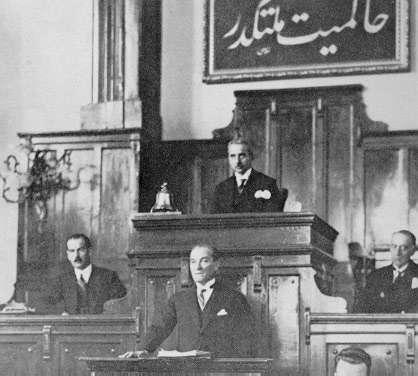
“On the nineteenth day of May of the year 1335, I landed at Samsun.”
The first sentence of the Nutuk · 15–20 October 1927An accounting of six days
He prepared the Nutuk for months with his own hand, and read it at the congress of the Republican People’s Party over six days, for a total of more than thirty-six hours. The text opens with the picture of the day he landed at Samsun:
“On the nineteenth day of May of the year 1335, I landed at Samsun. The situation and the general view:
The group of powers to which the Ottoman State belonged had been defeated in the World War; the Ottoman army had been battered on every side; an armistice with heavy terms had been signed. Through the long years of the great war, the nation was weary and poor.”
In today’s wordsOn 19 May 1919 I landed at Samsun. The general situation was this: the group the Ottoman State belonged to had been defeated in the First World War; the Ottoman army was worn down everywhere; an armistice with heavy terms had been signed. Through the long years of war, the nation had become weary and poor.
Source: Nutuk (1927), Part I. (1335 is the year 1919 in the Rumi calendar.)
The draft of a textbook
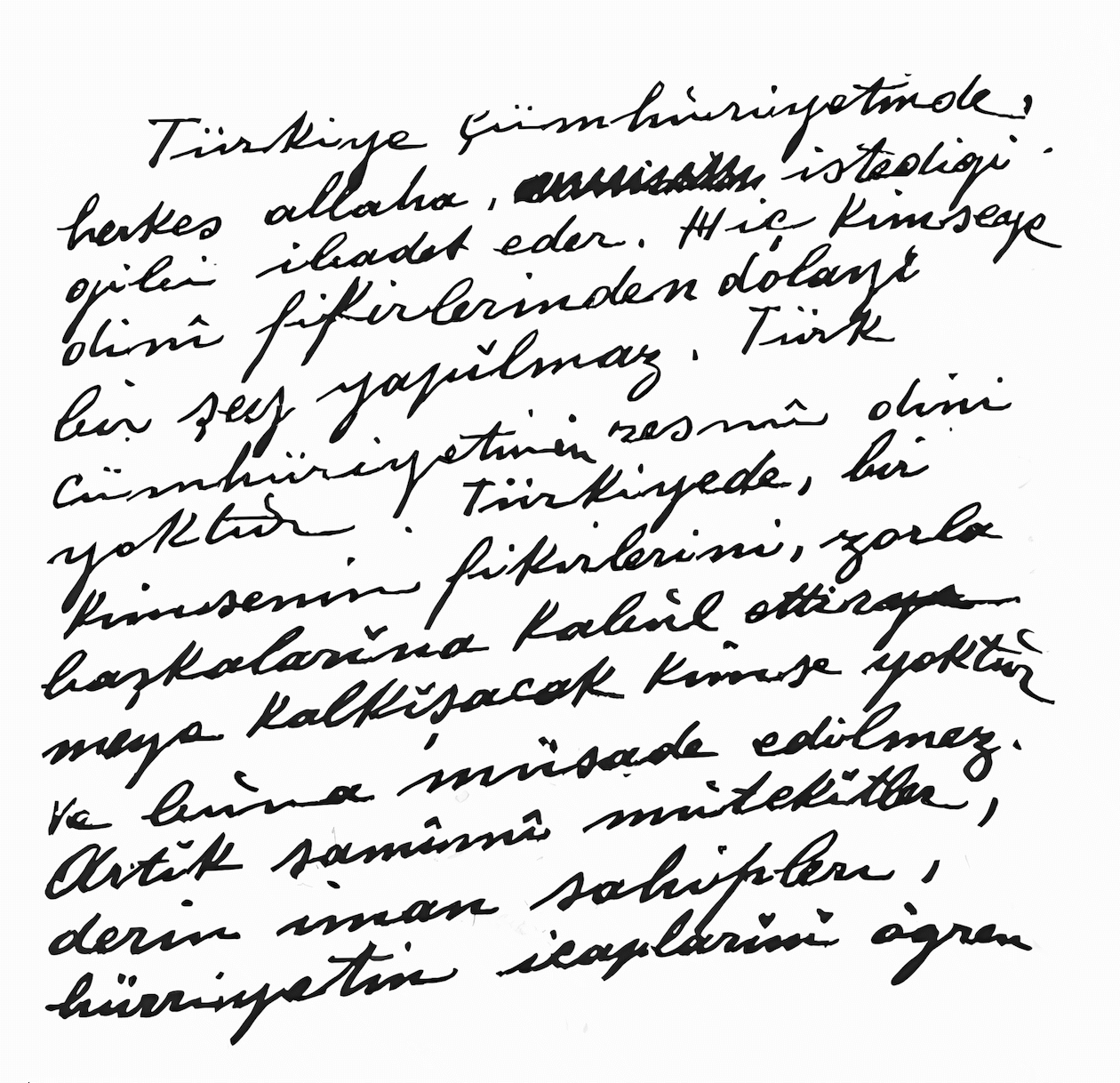
For use in Afet Hanım’s civics lessons, he wrote in notebooks, with his own hand, what a republic, democracy and citizenship are. These notes were printed under the title Vatandaş İçin Medeni Bilgiler (Civics for the Citizen). One page, written in the new letters, reads as follows:
“In the Republic of Turkey, everyone worships god as he wishes. Nothing is done to anyone because of his religious ideas. The Turkish Republic has no official religion. In Turkey, there is no one who would attempt to force his ideas on others, and this is not permitted.”
Source: the handwritten notes Atatürk wrote for Medeni Bilgiler (published by Afet İnan; an image of the handwriting is below). The text is given as spelled on the page; a word he crossed out while writing has not been included.
A few lines on language
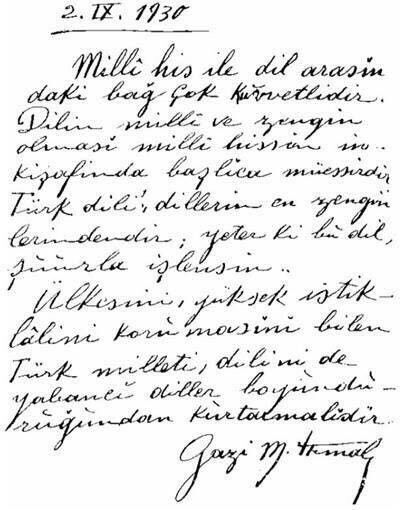
Two years had passed since the Alphabet Reform. The question of language was now one of the subjects he thought about most. He wrote this short note with his own hand and signed it “Gazi M. Kemal”.
“The bond between national feeling and language is very strong. That a language be national and rich is the chief factor in the development of national feeling. The Turkish language is among the richest of languages; provided only that this language is worked with awareness.
The Turkish nation, which knows how to protect its land and its high independence, must also free its language from the yoke of foreign languages.”
In today’s wordsThe bond between national feeling and language is very strong. A language being national and rich is the main factor in the growth of national feeling.
Source: Atatürk’s signed handwritten note dated 2 September 1930 (image alongside).
A geometry book
About a year and a half before his death, at Dolmabahçe, he wrote a small geometry book of forty-four pages. His aim was to show that mathematics could be taught in Turkish. In 1937 the book was printed by the Ministry of Culture, without the author’s name, as a guide for teachers and textbook writers.
çember (circle) · teğet (tangent) · çap (diameter) · eşit (equal) · dikey (perpendicular) · konum (position) · boyut (dimension) · uzay (space) · bölü (divided by)
NoteThese words, known today to every schoolchild, entered geometry lessons through this book. At the end of the book there is a list showing the old and new equivalents of the terms.
Source: Geometri (Geometry), Ministry of Culture, 1937; the preface by Agop Dilaçar to the 1971 Türk Dil Kurumu edition.
A will of a single page
His illness was advancing. On a Monday morning, at Dolmabahçe, he wrote his will with his own hand on a single sheet of paper. The next day, in the presence of Secretary-General Hasan Rıza Soyak and his doctor Neşet Ömer İrdelp, he handed the sealed envelope to the notary. The envelope was opened in Ankara on 28 November 1938, eighteen days after his death.
“I leave and bequeath all the cash and shares I own, together with my movable and immovable property at Çankaya, to the Republican People’s Party, under the following conditions:
- The cash and shares will, as at present, be made to yield interest by the İş Bankası.
- From each year’s income, for as long as they live and as long as the honour of their relation to me remains intact, there shall be given a thousand lira a month to Makbule, eight hundred to Afet, six hundred to Sabiha Gökçen, two hundred to Ülkü, and to Rukiye and Nebile the present one hundred lira each.
- For S. Gökçen, money will also be given separately so that a house may be bought.
- For as long as Makbule lives, the house she lives in at Çankaya will also remain at her disposal.
- The children of İsmet İnönü will be given the help they need to complete their higher education.
- Each year the remaining amount of the income will be allotted, half and half, to the Turkish Historical and Language Societies.
K. Atatürk”
In today’s wordsHe left all his money and shares, and his property at Çankaya, to his party under conditions. From the income, lifelong monthly allowances were to be paid to his sister and his adopted daughters, İsmet İnönü’s children were to be helped with their studies, and everything remaining was to be given each year, half and half, to the Turkish Historical Society and the Turkish Language Society.
Source: Atatürk’s handwritten will, 5 September 1938 (the original is in the State Archives). The text follows the publication made from a photocopy of the original document.